
Back
December 11, 2025 | Timothy Gotcher
Is Paint Correction Necessary Before Ceramic Coating?
| Vehicle Type | One Layer Estimate | Two Layers Estimate | Recommended Bottle Size |
|---|---|---|---|
| Compact / Sedan | 10ml - 15ml | 25ml - 30ml | 30ml (Risky for 2 coats) or 50ml |
| Small SUV / Crossover | 15ml - 20ml | 35ml - 40ml | 50ml |
| Large Truck / Minivan | 25ml - 30ml | 50ml - 60ml | 50ml (One coat) or 80ml+ |
| Motorcycle | 3ml - 5ml | 8ml - 10ml | Sample Size or Share a bottle |
If you live in Lewisville or the greater DFW area, you know that keeping a vehicle looking pristine is a constant battle. Between the intense Texas sun baking your clear coat, the dust kicked up from constant construction on I-35E, and the unpredictable weather, your car’s exterior takes a beating every single day. It is no wonder that so many local drivers are turning to modern solutions to protect their investment. You have likely heard the buzz surrounding ceramic coatings—that glass-like, hydrophobic shield that makes washing your car a breeze and keeps it shining for years.
However, when you start researching the process or requesting quotes, you often encounter a term that can be confusing and significantly impacts the price: Paint Correction.
A common question we hear at Eco Pal Mobile Detail is, "Is paint correction really necessary? Can't we just apply the coating directly to the paint?" It is a fair question. After all, if the goal is protection, why does the paint need to be polished first?
The short answer is yes, paint correction is absolutely necessary if you want your ceramic coating to look good and last as long as advertised. To understand why, we need to dive into the science of car paint, the physics of light, and the chemistry of how ceramic coatings bond to your vehicle.
Understanding Your Vehicle’s Clear Coat
To appreciate the necessity of paint correction, you first have to understand what we are actually working on. Modern vehicles are painted in three primary layers: the primer (the foundation), the base coat (the color), and the clear coat. The clear coat is a transparent layer of paint that sits on top of the color. Its job is to protect the color from UV rays and oxidation, and to provide that glossy shine we all love.
However, the clear coat is also the layer that sustains damage. When you see "spiderweb" scratches on a car in a parking lot under the sun, you aren't seeing damage to the color; you are seeing millions of microscopic cuts in the clear coat. These are often caused by automatic car washes, improper hand washing techniques, or even just brushing up against a dusty car.
These microscopic scratches do something detrimental to your car’s appearance: they scatter light. When sunlight hits a perfectly flat surface, it reflects directly back to your eye, creating a deep, wet-looking mirror reflection. When sunlight hits a scratched surface, the light bounces off the edges of those scratches in a thousand different directions. This light scattering is what makes paint look dull, flat, and swirled.
The "Magnifying Glass" Effect
This brings us to the most critical reason why you simply cannot skip paint correction before a ceramic coating.
Imagine you have a beautiful photograph, but it is covered in dust and fingerprints. If you take a thick, clear piece of glass and lay it over that photograph, the glass doesn't hide the dust and fingerprints. In fact, it often makes them more visible because the glass adds depth and clarity to everything beneath it.
Ceramic coating works in a very similar way. It is a semi-permanent, transparent layer of silicon dioxide (SiO2) that hardens into a glass-like shell over your paint. It is designed to enhance gloss. If you apply this high-gloss shell over swirled, scratched, or oxidized paint, you are essentially locking those defects in.
Because the ceramic coating has such a high refractive index (meaning it bends light in a way that creates shine), it acts like a magnifying glass. If you coat a car that hasn't been corrected, the scratches underneath will often pop out even more than they did before. Once the coating cures, those defects are sealed beneath a hard layer of protection. The only way to fix them at that point is to abrasion-polish the coating off and start the entire process over from scratch.
At Eco Pal Mobile Detail, we believe in doing the job right the first time. Applying a premium product over a damaged surface is a disservice to the vehicle and the owner.
But My Car is Brand New. Do I Need Ceramic Coatings?
This is perhaps the most common misconception we encounter. Many drivers assume that because they just drove their car off a dealership lot in Lewisville, the paint is flawless. Unfortunately, this is almost never the case.
From the moment a car leaves the factory, it is exposed to hazards. It travels by train (where it is exposed to "rail dust," or tiny iron particles that embed in the paint) and by truck. Once it arrives at the dealership, it sits on the lot exposed to the elements.
Worse yet is the "make-ready" process at many dealerships. When a car is sold, it is often hurriedly washed by porters using dirty mitts or run through an abrasive automatic wash. In some cases, dealerships will use a rotary buffer to apply a quick glaze, leaving behind what we call "holograms" or buffer trails.
We have seen brand-new vehicles with less than 50 miles on the odometer that have significant swirling and marring. While a brand-new car might not need the aggressive multi-stage correction that a 10-year-old truck needs, it almost always requires a fine polish to remove factory haze and dealership-inflicted damage. This ensures that when we lock in the shine with a ceramic coating, we are locking in perfection, not mediocrity.
The Chemistry of Bonding
Beyond aesthetics, there is a functional reason for paint correction: durability.
Ceramic coatings are not just a wax that sits on top of the surface; they are a chemical compound designed to bond with the clear coat on a molecular level. For this chemical reaction to happen effectively, the surface must be clinically clean and as level as possible.
Think of your paint’s surface like a mountain range. To the naked eye, it looks flat, but under a microscope, those scratches and contaminants look like peaks and valleys. If you apply a coating over these peaks and valleys, the coating cannot form a uniform, continuous layer. It may have trouble bonding properly in the "valleys" of the scratches, creating weak points in the protection.
Paint correction levels the "mountains." By shaving down the clear coat by a fraction of a micron (thinner than a post-it note), we create a smooth, flat surface. This allows the ceramic coating to cross-link evenly across the entire panel. A coating applied to corrected paint will last longer, perform better, and shed water more aggressively than a coating applied to neglected paint.
Finding the Best "Ceramic Coating Near Me" in Lewisville
When searching for "Ceramic Coating Near Me" in Lewisville, you might be overwhelmed by the variety of options, from automatic car washes offering "ceramic wax" (which is different from ceramic coatings) to high-end detailing shops.
For Lewisville drivers, choosing a service often comes down to trust, quality, and environmental responsibility. Eco Pal Mobile Detail stands out by offering top-tier ceramic coating and paint correction services at our facility. We understand that your time is precious, and we work efficiently to ensure a smooth process without unnecessary delays.
What makes us unique is our commitment to eco-friendly practices. While traditional detailing services can sometimes rely on harsh chemicals, we use eco-conscious products that prioritize environmental safety. Our products are chosen for their ability to provide high-quality results without harming the environment, your family, or pets—while still effectively correcting tough clear coats.
The Eco Pal Paint Correction Process
To give you a better idea of what you are paying for, let’s walk through what actually happens during a paint correction service. It is far more involved than a simple wash and wax.
The process begins with a thorough decontamination wash. We strip away any old waxes or sealants that might be hiding defects. We then use an iron remover chemical to dissolve embedded metal particles (like that rail dust we mentioned earlier) and a clay bar to physically pull out contaminants that have bonded to the paint. By the time we are done with this step, your paint should feel as smooth as glass to the touch, even if it still looks swirled.
Next comes the trial phase. Every car’s paint is different. Some manufacturers use "hard" paint (common on German cars) while others use "soft" paint (common on Japanese cars). We test different combinations of polishing pads and compounds on a small section of the vehicle to find the perfect recipe that removes the defects without removing unnecessary amounts of clear coat.
Then, the real work begins. Using dual-action polishers and high-intensity lighting, we systematically work around the vehicle, inch by inch. We make multiple passes over every panel, checking our work constantly to ensure the scratches are actually being removed, not just filled in with oils.
Once the correction is complete, we perform an "IPA Wipe." This involves wiping the entire car down with an isopropyl alcohol solution to remove any polishing oils or residue. This leaves the paint completely "naked" and surgically clean, ready to accept the ceramic coating.
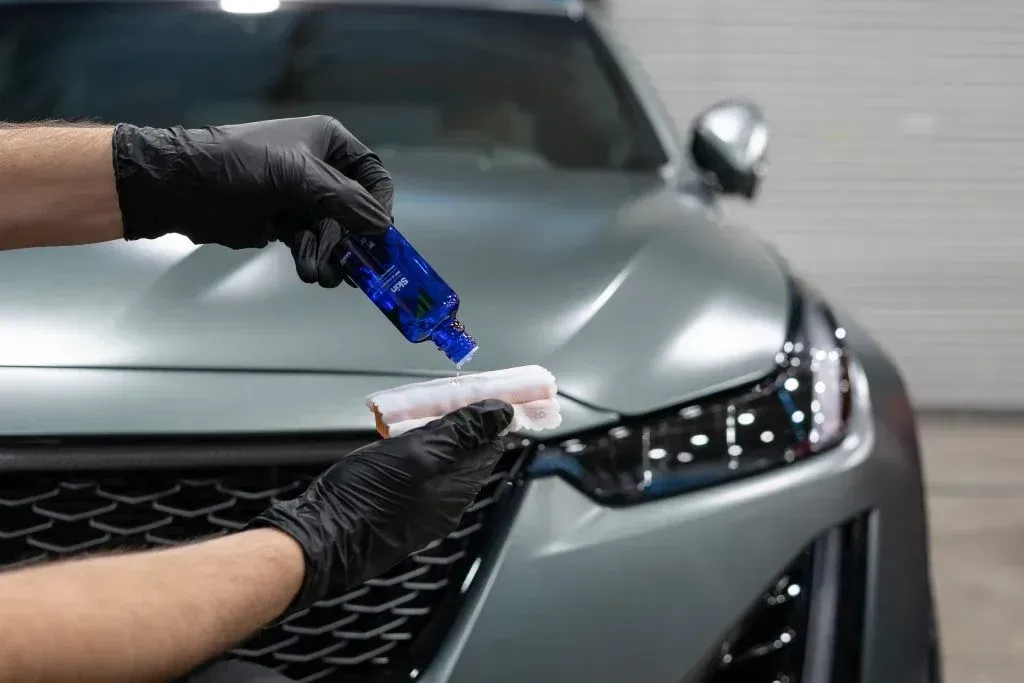
Only then do we apply the coating. It is applied in small sections, allowed to "flash" (bond), and then carefully leveled with plush microfiber towels to ensure no high spots remain.
Is Full Ceramic Coating Worth the Investment?
There is no denying that paint correction adds to the cost of a detail. It is labor-intensive, requires expensive equipment, and demands a high level of skill and patience. However, when you view ceramic coating and vehicle detailing as long-term investments, the value becomes clear.
A ceramic coating without paint correction is like building a house on a cracked foundation. You might get a few months of hydrophobic behavior, but you won't get the stunning, head-turning gloss that these products are famous for, and the protection will likely fail prematurely.
By investing in paint correction, you are restoring your vehicle to a condition that is often better than the day it was made. You are increasing its resale value and ensuring that the ceramic coating can perform at its absolute peak.
Conclusion
So, is paint correction necessary before ceramic coating? If you care about the longevity of the protection and the quality of the finish, the answer is a resounding yes. It is the difference between a car that looks "okay" and a car that looks like a mirror rolling down the street.
At Eco Pal Mobile Detail, we take pride in educating our clients. We aren't here to upsell you on services you don't need; we are here to provide the results you dream of. We want you to look at your car in the grocery store parking lot and smile because it looks better than the brand-new model parked next to it.
If you are ready to transform your vehicle and protect it from the Lewisville elements, we are ready to help. Stop searching endlessly for "Ceramic Coating Near Me" and trusting your vehicle to the lowest bidder. Trust the experts who bring the shop to your driveway.
Contact Eco Pal Mobile Detail today. Visit us at ecopalmobiledetail.com to book your appointment. Let’s reveal the true potential of your paint.